
Hazrat’s System, Order and Majlis
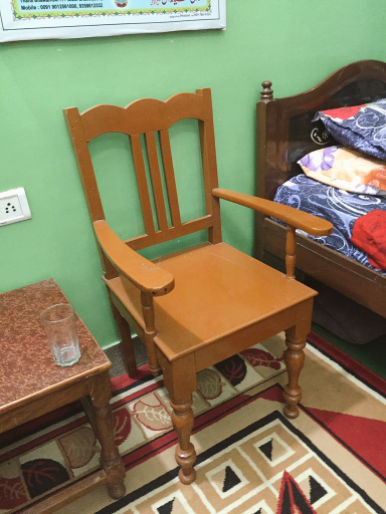
The above discussion was in Hazrat’s sehdari proper [the veranda in front of the chambers], between the eastern and western walls. Hazrat was sitting on a mat placed in front of his desk. In his hand he had a Tasbeeh. A watch was in front of him. On the desk there was stationery. A large clock was hanging on the wall.
Visitors could view Hazrat’s schedule and programme hung on the wall. It serves as a lesson to a neglectful person on the precious nature and importance of time.
Moulana was seated on the left, and after him we were seated.
The rules and etiquette of sitting and seating were all fixed for Hazrat’s Majlis [formal or informal assembly]. In everything, there was a manner and procedure. In every matter, there was system and order.
This was the Majlis-e-Khaas [the special gathering of Hazrat’s close Mureedeen]. After Zuhr in the Majlis-e-Aam [the open gathering] the procedure was that ordinary Taalibeen and newcomers would sit on Hazrat’s right in the ample space of that side of the sehdari. Where a person found space, he sat. No one was allowed to dislodge another from the latter’s place or make him shift up.
The left side was relatively cramped. Only about seven or eight people could sit here. Here special people sat. A few people could also sit in front.
Hazrat spoke considerably. Remember that it was 1928 AD [when there was considerable political jockeying on the matter of the Khilaafat], and in the audience was the director [Moulana Daryabadi himself] of the daily Hamdard [published by Mohammad Ali Jauhar the chief espouser of the Khilaafat]. In the lengthy audience of the morning and afternoon, speaking on the political situation was unavoidable. Hazrat spoke so rationally that all my suspicions evaporated.
Who says that Hazrat was a government agent?!!! Wa Laa Haula Wa Laa Quwwata! Whoever said such, knowingly or unknowingly, spoke a lie!
This was the talk of a sincere Muslim, and such a Muslim who was never second to any Khilaafati [supporter of the Khilaafat Movement], in Deeni fervour and national pride. Voices of the vision of Pakistan and establishment of a pure Islamic government came afterwards; for the first time I heard these topics here.
Hazrat was only opposed then to our modus operandi. But this was not an insurmountable problem. In the actual aim, that is liberation from a kaafir government and establishing Darul Islam, Hazrat was not far behind us. It is quite possible that, in fact, he was a bit ahead of us.
The major part of the talk was naturally related to Deen and Tasawwuf. Hazrat mentioned the stories of some Buzrugs in such a manner that it appeared like he was portraying our ideals and goals. I said to myself, “Look at that. His heart is a mirror. All our inner feelings are being reflected on his heart. Who can be a greater Saahib-e-Kashf and Saahib-e-Karaamat than him?”
Later, years later, and that too by virtue of Hazrat’s blessed Suhbat [company], it dawned that in front of the baseerat and firaasat [insight and intuition] of a Mu’min, material revelations, the visions of the yogis and hypnotism are nothing at all. How can those base things be compared to this celestial power? That superficial gilding has no worth in front of this transcendental truth.
Be that as it may, I got up overwhelmed by this knowledge of the unseen and perception of what is in the next man’s heart.